Showing posts with label Lancia. Show all posts

Friday, 10 August 2012

Time for Auction!

This August is definitely a great month for Classic Cars Auctions. Some of the most amazing cars in history will go under the hammer and I sure regret not being able to witness in person the exciting last moments of ownership for those selling them.

The majestic and unique Manta Bizzarrini is set to trade hands in Pebble Beach at Gooding and Company's auction on the 18th and 19th. Very first design of the newly founded firm, the Manta arguably marks the appearance of the wedge style and "the seventies" in car design. Starting from the innovative frame of the Bizzarrini P538 the car seems to wipe out all the designs made before with an uncompromising 15 degree windshield, three seats with the driver in the central position and its outrageous color scheme. The estimate seats comfortably between 1.3 and 1.5 million dollars. I sure hope this car more luck than what happened to the even more revolutionary Lancia Stratos HF which missed the lower estimate shy of €200.000 last summer.
Find here some pictures I took some years back at the Goodwood Festival of Speed.


The Manta will be in great company, the catalogue also offers a striking 1962 Ferrari 400 Superamerica Coupe Aerodinamico ($1,750,000 - $2,500,000), 1957 Ferrari 500 TRC ($3,750,000 - $4,500,000) and three famous prototypes like the 1970 Monteverdi HAI 450 SS ($600,000 - $800,000), 1964 Ford GT40 ($5,000,000 - $7,000,000) and the 1957 Ferrari 250 GT LWB California Spider ($6,000,000 - $8,000,000).
My personal favourites probably being the 1955 Maserati A6G/2000 Berlinetta ($1,500,000 - $2,000,000) and the almost perfect 1959 Lancia Flaminia Sport ($375,000 - $450,000).
Click HERE to take a look at the whole catalogue.
If you were impressed by the offer of Gooding and Company then you should not be disappointed by RM Auctions, except for the fact that they are offering two Auctions this month alone! On the 17th and 18th in Monterey they will offer a frankly striking array of vehicles. It is very hard for me not to publish here most of the catalogue. One of the pure gems is the 1955 Ferrari 410s Berlinetta, the beauty and the beast itself. A car rarely seen in meetings and events and one of the most beautiful shapes ever conceived by Scaglietti.
Also in the catalogue no less than 3 true everlasting icons of car racing history such as the 1971 Porsche 917/10 Spyder Can-Am ($2,900,000-$3,500,000), the "Icon" itself 1968 Ford GT40 Gulf/Mirage Lightweight that also served as camera car in the legendary "Le Mans" movie and the 1987 Porsche 962 IMSA Camel GT ($1,200,000-$1,600,000).
Porsche is also well represented by the 1981 Porsche 935 JLP-3 IMSA ($1,300,000-$1,800,000) and no less that the actual factory works prototype of the 1963 Porsche 904/6 Carrera GTS ($1,800,000-$2,200,000).
Last but not least there's the novelty of Virgil Exner's 1960 Plymouth XNR concept car. Admittedly not one of my favourite cars. I find its shapes too "cartoonesque" for my tastes. But then again... how often does it happen to see such a famous unique car trading hands?
Find here some of the videos RM produced to present this particular auction.
It's common for these auction houses to offer for sale such incredible vehicles and to reach equally incredible bids. That's why the real surprise of the month is RM's auction in Denmark, presenting the Aalholm collection on the 12th of August featuring more than 175 motor cars, formerly part of the Automobil Museum. All lots will be presented without reserve and in my opinion, at very conservative estimates. Possibly because most of the cars are not restored to RM's incredible usual level or possibly in an attempt to try and attract a wider audience. Whatever the reason, there will sure be some nice bidding action and some smiley faces at the end of the day.
The museum's offer stretches from a 1958 Trojan Cabin Scooter with a high estimate at £740.31 (really??) to an uber cool 1926 Citroën Kegresse Half-Track that is expected to go for as little as  £2,300.
The queen of the auction in my opinion will be the 1954 Arnott Sports, Arnott's only Lea Francis (push-rod - twin cams high in block) powered Sports from a production of seven cars. Miss Daphne Arnott founded the make in London in 1951 and produced cars for roughly 6 years. It was a brave attempt and she also managed to put a car on the grid of the 1955 and '57 Le Mans 24 Heures, where it was stopped by technical failures. This is truly a nice piece of car and the estimate of 2,300 to 3,900 GBP is to my eye,  hard to believe.
Go to RM's website for all the info you may need and don't forget to subscribe to their twitter account for a live feed of the auctions!

Friday, 27 July 2012

A quick trip in some Lancia rally cars

Pirelli decided to present his new line of tires for performance classic cars in the best possible way, ever.
Select some journalists and put them in the navigator seats of some of the greatest Lancia ever made with some of the best drivers of the day at the wheel.
Watch Chris harris from DRIVE's youtube channel having what is his words is "the best day of my working life".

Priceless.


Monday, 2 July 2012

Six wheeler's Craze

Goodwood's Festival of Speed this year will be remembered for being the first ever gathering of all the six wheelers that ever managed to get on the books of Formula one and that ever will, for that matter. This is because the latest of the trio, the Williams FW08B, finally managed to convince FIA to ban this bizarre approach for good in 1983. This happened right after news about the car started to spread and  the FW08B became yet another F1 car that would have never raced.
Williams FW08B

Williams decided that the best way to have a go at this idea was to put the extra two wheels at the very back of the car, adding an extra axle behind the rear wheels to help the car delivering power to the ground. This was March's approach in its 1977's 2-4-0, yet another car that didn't effectively make it to the race track. It sure was and enormous advertising success, getting two covers of Autosport magazine respectively in December '76 and February '77. All this just thanks to two testing days at Silverstone, only 14 miles away from March's workshop.
March 2-4-0

Everybody knows that Enzo Ferrari knew how to keep pressure on the media and it is hence unsurprising that Maranello had to have a shot at it. They decided to put two extra front wheels on the rear axle. The car was tested at Fiorano by Lauda and Reuteman, the latter would end up crashing the newborn 312T6 on the 12th lap of the second testing, the car burnt to the ground. 

Ferrari 312 T6

The desired effect on the press didn't give enough satisfaction and italian magazines started to speculate on the picture of a mysterious car this time sporting 8 wheels, 4 in the front and 4 in the back. The car was immediately named the 312T8. Now look carefully at the extra wheels in the picture. Can you spot the hoax? Cunning.
The Mythological Ferrari 312 T8

Something similar was attributed to Lotus the year before when this picture appeared on a belgian magazine but the date was more than a giveaway. It was the 1st of April. I won't comment further about the following side shot taken the following year. It is pretty obvious what's going on there.
Lotus' non existing six wheelers

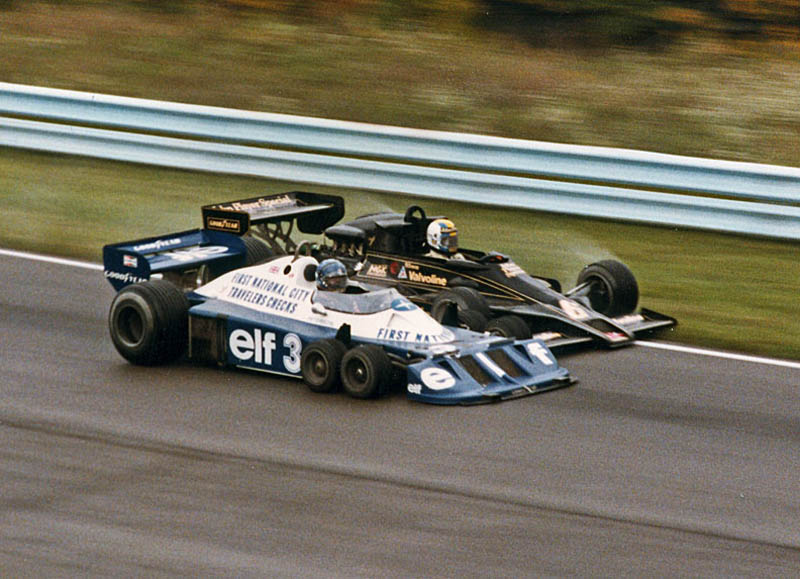
It's interesting how the first ever six wheeler F1 car would have also been the only one to ever race and with with decent results too. The Tyrrell P34 in fact was the only one of the lot with four wheels at the front and raced in '76 and '77 counting 30 races 1 win, 1 pole and 3 fastest laps. This is obviously the most famous six wheeler ever and the story of this car is very easy to find everywhere, I see no point in talking about it here.
Ronnie Peterson battling a Lotus in his Tyrrell P34


Other attempts outside F1?
March's and Williams layout was tried before by Pat Clancy on his "Special" in the 1948 and 1949 Indianapolis 500s. Clancy was a dirt track driver and owner of a little trucking company, you can start to understand where he got the idea. He built the car in his garage and he did manage to qualify in both attempts. Successful? Nope. 12th in '48 and DNF in '49. Whatever he was gaining in the straights was hopelessly lost in the curves in which the car was desperately trying to keep going straight.
The Pat Clancy Special

Ferrari's "rear sandwich" has been used in many occasions across the twenties and thirties especially when lending GP cars to hill climbs, not at all unusual at the time. This picture shows an Auto Union Type C but I do remember seeing this solution on an ERA, a Frazer Nash and a Maserati even after WWII.
Auto Union Type C

The six wheels solution has been also studied in land speed record vehicles like the now lost 1937's Thunderbolt or 1939's stillborn Mercedes T80. Both cars became victims of the second world war. The Thunderbolt was in New Zealand for an exposition when the war exploded. It will be left in a barn for years until a fire burned the building to the ground. The vehicle probably scrapped like any other piece of metal.
The Thunderbolt

Ferdinand Porsche designed the Mercedes T80 to be equipped with a 44.5 litre Daimler-Benz DB 603, an increased displacement derivative of the aircraft engine which powered the Messerschmitt Bf 109. With its skillful engineering, advanced aerodynamics and the engine's 3000 hp it was expected to reach a projected speed of 750 km/h (465 mph). War struck and it never ran a mile.
Mercedes T80

Funny enough the most recent attempt to my knowledge came from the World Rally Championship. In 1984 rear wheel driven Lancia 037 was struggling to defend its throne of world champion from the unstoppable rise of the unlimited and fearsome 4WD Group B cars. It did manage to tackle Audi's Quattro and Peugeot's 205 T16 for over a year but halfway into '85 the battle was obviously about to be lost forever. In a last attempt to try the unthinkable Lancia's engineers tested extensively a "rear sandwich" layout but as Peter Collins writes in his book about this fearsome car "they showed no vantage at all". The tires for this experiment were courtesy of Goodyear (not the usual Pirelli, also a main sponsor) and is is pretty clear that it was all a stunt in order to distract from the development of the 038, aka the Delta S4, that was being tested in great secrecy. They got to the extreme of painting the prototype in camouflage colours and have the test driver dressed in olive green too!
Lancia 037 in 1985


So at the end of the day the only layout that proved any real benefit is Tyrrel's with its T34 and it is interesting to notice that no one ever tried to emulate it, being interested in the extra two wheels to create a stir rather than anything else, really.
Of course using this layout there's 2004's Covini C6W but this car has no racing history and is in my opinion really really ugly. My apologies to Covini.

Thursday, 14 June 2012

Treasures from Greece

We all know about the economic climate in Greece and it was just a matter of time for interesting classic cars to appear on the market. This seems to be Dimitrios Spyropoulos' Veloce Classic and Sports good chance to get some very interesting cars up for sales. His company is based in West London and thou some cars still seem to be in Greece judging by the pictures, his business seems well established and I would be happy to go and check it out if anyone's interested.
These are three cars that I found particularly interesting.
This Lamborghini Miura S appears to be a present from Aristotle Onassis to Stamatis Kokotas, a famous Greek singer in Greece. The ad also states "The car needs complete restoration. The engine is overhaulted by the Lamborghini factory and is on preview from the Lamborghini Museum in St. Agata." A quick check on chassis numbers reveals that the car was completed on the 24th of December 1968, and whether chassis and engine match, the color should be Red and Black, with Blue interior. Some specialised websites also note that is was rebuilt as 434th car. Sure there's some interesting history to discover about this car.
Another little gem is this Fiat Ghia 1500. I always liked this model and sure it would be a welcomed car in many events. It looks very straight in the pictures and I really don't think it's a car that is worth messing too much with, therefore it should be as good as it looks. If the pictures match the real conditions of the car, the price seems right at£15500 or near offer. 
My personal favourite of the whole lot thou would be this Lancia Flaminia Zagato 3C, one of my all time favourites. The car is said to be modified at the source for hillclimb races and would be interesting to find out who actually made that unique one-piece bonnet. The story of this car could very possibly make it one of the most amazing Flaminia in the world.
Please contact me if you need any more info or better still, if you want me to visit Dimitrios' London office. I think I'll get in contact with him very soon.

Wednesday, 25 April 2012

CCT back to business!!

Unfortunately some unfortunate events in my personal life kept me away from this blog for a couple of months but this time gave me a chance to collect a lot of material for future posts. Let's get back to business by taking a look at a couple of interesting cars capable of being "future regrets".
My first choice would be an old passion of mine and in my opinion one of the cars that still awaits the respect it fully deserves, especially here in the UK. This Lancia Beta Montecarlo  is advertised also on ebay for £1200 and no reserve. It sure needs some works to get back on the road, but it seems quite solid in the pictures and it would definitely be worth a trip. If you are not familiar with the gifted and troubled mid engined Beta Montecarlo take a look at this website.
The second eye catcher on ebay lately has been this Berkeley T60. I've asked my dear friend Ray Bell (from the Berkeley's Club) for a quick description and evaluation. "Berkeley produced about 4200 cars altogether, from 1956 until 1961, when the company went out of business.
The T60, launched in August 1959 sold more than any of the other models - altogether around 1800 were made. The design was derived from the earlier 4 wheeled 'Sports 328', using the same 328cc Excelsior twin 2 stroke engine, with a 4 speed gearbox driving the front wheels. Much of its popularity was due to the fact that a three wheeler could be driven on a motorcycle licence provided that the reverse gear was blanked off. 
Increasingly these ground-breaking cars are seen as classics worthy of restoration, and this T60, fitted with a comparatively rare hardtop, looks like a good specimen of a standard T60.
Typically a well restored T60 will fetch £3,000 - £3,500. "
At the moment 17 bids are fetching £2,800 but are not crossing the reserve price yet. My bet is that the car  will get closer to £4.000 than £3.500 but I have a feeling it will not be enough for the reserve. 
I will definitely keep an eye on this auction, the ingredients are the ones for a complete oddball. The seller doesn't know how to spell and anyway doesn't seem to know the correct name of it. It is in fact a Jensen GT (as it says on the bumper) and not a Jenson Healy or a Jensen Healey, the connection with Healey ended in 1975. The description and pictures would keep me away from it but 15 bids certainly show a lot of interest for this attractive shooting brake. Only 473 were ever made and under the bonnet there should be a 1.973cc Lotus twin-cam,  but with perfect examples being evaluated around £6.000 I would say that this is a far cry from a wise investment. 15 bids, £460 so far, 4 days and no reserve make for an interesting auction to keep an eye on, thou.

Wednesday, 14 December 2011

Marcello Gandini Story - Part 1


I still have to find a comprehensive collection of the works of Marcello Gandini, therefore I decided to open a new series of posts trying to cover all his beautiful creations. The secluded genial designer that arguably gave us the seventies - and the last car design revolution that we care to remember - has never been fit for celebration and even less for giving satisfaction to the press. When asked if between all these cars, there is one that he remembers in particular he said: “I do not have the habit to associate a drawing to the end result obtained. I am not bound to the success of a particular car, rather the memory of the persons that collaborated to the project and the circumstances under which they were created (...) If I think about the Lamborghini Marzal, I think of the night previous to the launch in Geneva; We had only few hours to end the work and at midnight we still had the car dismantled on the floor…. However, we succeeded in time and the following morning left with destination Geneva.Talking about the shockingly groundbreaking Lancia Stratos HF seven years after its presentation at Turin's motor show in 1970 he only ended up commenting: “The very first Stratos was designed as freely as the [Autobianchi] Runabout and reached the aim for which it was intended: to establish a bridge between Lancia and Bertone. Having established the bridge, Lancia asked us to come up with an idea for a new sports car that would go rallying in the world championships.” It sure is the most beautiful "bridge" ever made. But more about the HF when we'll come to it.
If you have any kind of familiarity with Turin, you would not be surprised about his attitude. It is a town that keeps things for itself, a town that hates showing off and is almost bothered by publicity. Things have changed much in the last ten years in the heart Turin, since Fiat released its pressure on any kind of development in town. In 1938 Fiat still had to sharp its claws on the town but a faulty royalty allowed fascism to cast its horrid shadow on the Italian peninsula. On the bright side Marcello Gandini was born, just 19 days after another design icon as Giorgetto Giugiaro and 7 months after Leonardo Fioravanti. Must have been something in the water.
The little Marcello was born son of an orchestra director, studied music and sculpture and ended up working as interior designer. Apparently had his automotive epiphany when he first saw a Cord 812. He was impressed by the sense of speed and dynamism that those lines still express today. When a friend crashed his Osca asked Marcello to pen a body for it. The young interior designer was asked a full scale drawing for the wooden body buck to be produced and he did so by sticking together on the wall many sheets from the biggest drawing pad he could find. Giovanni Raniero, the man appointed for the wooden structure harshly told him "I can understand nothing!". The young designer didn't know that the standard was to start with the left profile and presented the right instead.

In 1963 he tried to work for Bertone, but the chief designer at the time, Giugiaro, refused to work with him. Thankfully Giorgietto left the company to open his own two years later and Gandini was hired to replace him. He would have worked there for the next 14 years. As soon as he arrived he was asked to complete one of the most important cars of all time and in effect, the first supercar as we know it today. The Lamborghini Miura. The story of this car is one of the most covered in motorsport publications but it will nevertheless deserve a post of its own.

Click HERE for part 2 - The Miura

Tuesday, 3 May 2011

24h Hours of Le Mans, June 14/15 1952


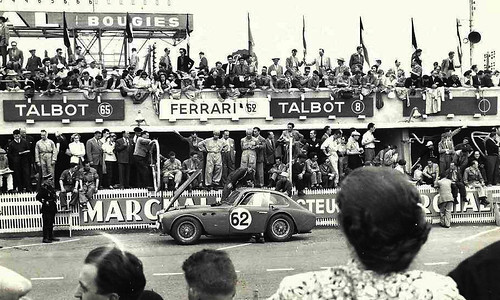
In 1951 the XKI20C came as a surprise to other Le Mans contenders, but in the following year the reputation of Mercedes-Benz and the 3.0 300SL preceded them. The performance of the streamlined coupés in the Mille Miglia suggested that they were superior in maximum speed to the Ferraris and Jaguars and certainly not inferior in road-holding, thus provoking some over-hasty revision in rival equipes' preparations. The Jaguars arrived with new bodies and ran their first high-speed trials during practice. They overheated and were partly and hopefully modified on the spot; many British hopes for victory were consequently centred on the DB3 Aston Martins. Ferrari was represented by an assortment of cars: 4.1, 3.0, 2.7 and 2.6, open and coupé.
Briggs Cunningham entered two lighter, shorter C4Rs and a C4RK coupe. Of the Talbots Levegh's at last looked like a contemporary sports car, and Gordini entered the dainty 2.3 which had done so well at Monte Carlo and was expected to put up another good performance at Le Mans (if it lasted). Lower in the capacity order came a 2.1 Morgan; two Frazer-Nashes and two Lancias in the 2-litre class; a Gordini, three Jowetts, a Porsche and an Osca in the 1.s-litre class; two IIOO-C.C. Porsches and one IIOO-C.C. Simca, six Renaults, a Panhard and two D.B.s; and, in the 750-c.c. class, three more Panhards. A first-class entry, despite the non-appearance of the expected Alfa Rameo and Pegaso teams, which on paper at any rate, promised a close-fought race.
The Cunningham coupe led at the end of the first lap but was soon overwhelmed by the two Ferraris of Ascari and Simon, which were setting a quite unrealistic sprint pace. The Jaguars, and the Mercedes, were quietly holding back at their pre-determined speed. On the sixth lap Ascari stopped with a slipping clutch, and returned to the race apparently intent only on putting the lap record out of reach of his rivals. Moss moved into second place and on the eighth lap Manzon took the Gordini past the two other Jaguars. Within the hour Parnell's DB3 coupe went out with rear-axle trouble and Poore soon followed with the second works Aston. The overheated Jaguars all retired in the second hour, the Mercedes began to move up and, as Simon faltered, Manzon led. He was followed by WaIters' Cunningham and Kling, the latter shortly to be delayed by the defective dynamo which ultimately put him out of the race.
At midnight the Gordini led (at 104.4 m.p.h.) by a lap from Levegh (95 laps), Lang and Helfrich (94), Chinetti (Ferrari, 92) and the Macklin Collins Aston Martin (91 laps). Fog in the small hours slowed the race to about 95 m.p.h. and positions remained unchanged until dawn. Then brake failure ended the Gordini's "win or bust" run, whereat Levegh's Talbot led the He1frich Niedermayer 300SL by the healthy margin of four laps and the Hemard-Dussous Panhard took over the lead on Index.

Mercedes-Benz seemed content to hold their  position on Sunday. The Porsche and Osca entries, still disputing the I.5-litre class, fell out, leaving it to the Becquart-Wilkins Jupiter (in repetition of the 1951 race). Aurelias, eighth and ninth overall at noon, commanded the 2-litres, while Porsche and Panhard led the 1100c.c. and 750c.c. classes respectively. Briggs Cunningham, who drove his own car for 20 out of the 24 hours, pushed on in a passionate effort to succeed.
In the early afternoon Lang's Mercedes passed its slowing sister car, a rear-axle failure put the last works Aston Martin out (leaving one privately-entered DB2 to represent the marque) and the Talbot in fifth place crashed. Then, with an hour and a quarter to go, a connecting rod on the leading Talbot snapped, and Levegh, who had consistently refused relief and was bemused with fatigue, was out of the race. The two Mercedes automatically won, deservedly in view of their superb preparation and control, but not perhaps without an element of luck. The Nash Healey was third, followed by the Cunningham, the Simca-Vincent Ferrari and the first of the Lancias. Altogether 17 oddly assorted cars of the brilliant field of 57 which started 24 hours earlier survived this most eventful race.

(source "The LE MANS 24-Hour Race" by David Hodges, Temple press Books, 1963 London)

Wednesday, 19 January 2011

Lancia D50

Beautiful as much as cursed, the Lancia D50 is without any doubt one of the most beautiful Formula One cars ever built. Brainchild of a genius of motorsport such as Vittorio Jano, it embodied all the Lancia spirit.
In a nutshell we are talking about a car that was the first and last F1 of the marque, the only one on the grid with a V8, the only one with the engine as a stressed chassis member, the only one with pannier tanks, the only one with gearbox on the rear axle and the only one whose engine was tilted 12 degrees. 
It would have taken a lot of courage to anyone, but not to Lancia. They put Alberto Ascari in the driving seat for the debut in the Spanish GP of 1954 and got the pole position straight away. 
A clutch failure will stop the car during the race.
Lancia’s brand new DOHC V8 was shorter than the other straight six and with a lower center of gravity. Tilting it 12 degrees allowed the propshaft to pass on the left of the driver’s seat and the 5 speed gearbox was on the rear axle. Jano also joined the wheels aerodynamically with pannier tanks on both sides. The car was extremely compact and well balanced, probably even too much for the driving style of the time. The “limit” for sliding was much higher and the was hardly space for recovery beyond it.
Ascari won the two pre-season races and luckily escaped a dive in Montecarlo’s harbour. He wasn’t so lucky four days later testing a Ferrari at Monza. That 26th of May took the life of one of the greatest drivers of all time and the hopes of Lancia which could not afford another experienced driver. He sold the F1 program to Ferrari.
The slightly different Ferrari D50 and Fangio will take home the World Championship for 1956.

Only two original survived in a museum and a collection in Turin.

From the spares a minimum of 7 replicas are known to be around the world.